The streets
The bull, Altıyol and Bahariye
Ask anyone on the Asian side where to meet and they'll say the same thing: at the bull. From that bronze animal the quarter's high street runs straight up to an opera house, and that short walk is most of what makes Kadıköy worth your afternoon.
Meet me at the bull
The bull is the single most useful landmark in Kadıköy: a life-size bronze animal, head lowered, standing on a stone plinth in the middle of a busy junction. For generations people have used it the way Londoners use the clock at Waterloo: "see you at the bull, six o'clock." Locals say "boğa" and point. That's it. That's the meeting.
There's a real history here, older than most people assume. The bronze was made in Paris by the French sculptor Pierre Louis Rouillard and commissioned by Sultan Abdülaziz back in 1864. So this is a 19th-century French animalier bronze that somehow ended up presiding over a tram junction on the Asian side of Istanbul. The statue didn't arrive directly, either; it moved around the city over the decades before it was finally set down at its current spot on Altıyol Square in 1987. Ask three Kadıköy residents how it got here and you'll get three slightly different stories.
Up close it is worth a proper look. The casting is good, the muscle and the curve of the horns convincing, and somebody is forever rubbing the nose for luck or climbing the plinth for a photo. This is no polite museum piece behind a rope. It's a street object the neighbourhood has adopted, and that is exactly why it works as a landmark.
If you remember one instruction from this whole guide, make it this: when in doubt, walk to the bull. Everything in central Kadıköy is a few minutes from it.
Six roads, one corner
The junction itself is called Altıyol, which means "six roads," and that is the literal truth of the place: six streets feed into one chaotic, cheerful corner. Trams curve through it. People cross against the traffic. Someone is selling roasted chestnuts in winter and corn in summer. Loud, all of it.
That noise matters, because it sets up the contrast that defines this part of town. Behind you, down toward the water, sits the market quarter, Çarşı, all fish stalls and shouting and narrow lanes. In front of you, climbing gently away from the bull, is Bahariye Caddesi: calmer, broader, made for walking. Altıyol is the hinge between the two, and standing at the bull a moment you can feel both moods pulling at the same corner.
For the record, the district as a whole, the bull, the market and these pedestrian streets, is covered well on the Kadıköy district page if you want the broader history.
Up Bahariye
Bahariye Caddesi is the avenue that runs from Altıyol up toward the opera house, and most of it is pedestrianised, so you can wander down the middle of the road without watching for cars. This is the quarter's high street in the old sense of the phrase. There are the big chain shops you'd find anywhere, yes, but threaded between them are the things worth slowing for: secondhand bookshops, a couple of grand old cinema buildings, bakeries, music shops, tea houses with stools spilling onto the pavement.
My honest advice is to treat Bahariye as a slow drift rather than a destination. Don't march. Step off into the side alleys whenever one looks interesting, then drift back onto the main avenue. Some of the best small cafés and record shops sit one street off Bahariye, not on it.
A few practical notes on the avenue:
- It runs slightly uphill from the bull, which you barely notice going up and definitely notice coming down with shopping bags.
- It is busiest in the late afternoon and early evening, when the whole quarter seems to come out to walk.
- Cinemas here have real character; even if you don't catch a film, the facades are worth a glance.
- Side streets off Bahariye hide most of the independent shops. Go looking.
It is, frankly, a lovely street to do nothing on.
The opera house at the top
Walk Bahariye to its far end and you arrive at the surprise that gives the whole avenue a point: the Süreyya Opera House. It is a jewel-box of a theatre, far smaller and more intimate than its grand facade suggests, and it has been standing here since 1927.
The backstory is a good one. A retired Ottoman officer named Süreyya İlmen built it as a venue for the neighbourhood, drawing on Art Deco fashion of the day and, the story goes, the theatres he'd admired in Paris. For most of the 20th century it actually ran as a cinema rather than an opera house, from around 1930 until the mid-2000s, before a careful restoration returned it to its founder's original idea. Today it houses the Istanbul State Opera and Ballet, with a main hall of a few hundred seats. Read the full history of the Süreyya Opera House before you go.
Want to see inside? Performances run only a few days a week and tickets are reasonable by big-city standards, but they sell out, so check the programme in advance rather than turning up hopefully on the night. Even closed, the exterior is worth the walk to the top of Bahariye.
What I like about it is the scale. This is not a vast national opera meant to overawe you. It is a small, proud, local theatre that the quarter built for itself, which is somehow much more in keeping with Kadıköy's whole character than a giant landmark would be.
That little tram
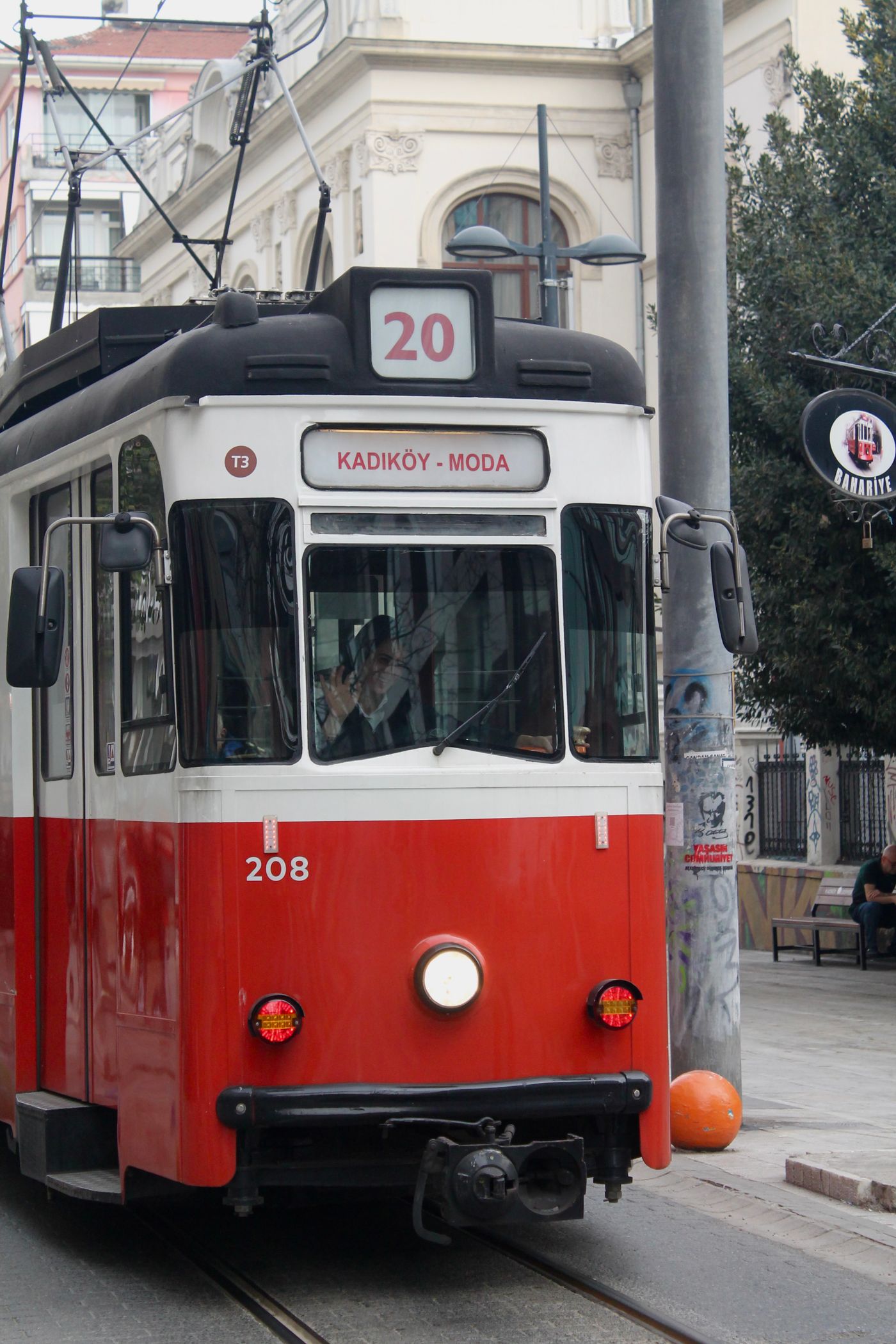
While you're walking the avenue, you'll keep meeting a small, old-fashioned tram, dark red or green depending on which car is running, trundling along at walking pace with "Kadıköy - Moda" on the front. This is the heritage line, the T3, and it is one of the quietly charming things about the quarter.
It opened in 2003 as a nostalgic, circular service on part of the old Route 20 tram alignment, and it loops clockwise from the Kadıköy area along Bahariye and around through Moda before coming back, roughly two and a half kilometres in all, with a handful of stops. The carriages are genuine vintage stock, secondhand from German systems, which is why they look and sound like nothing else on the road. The full story of Istanbul's nostalgic tramways, both sides of the city, is documented if you want it.
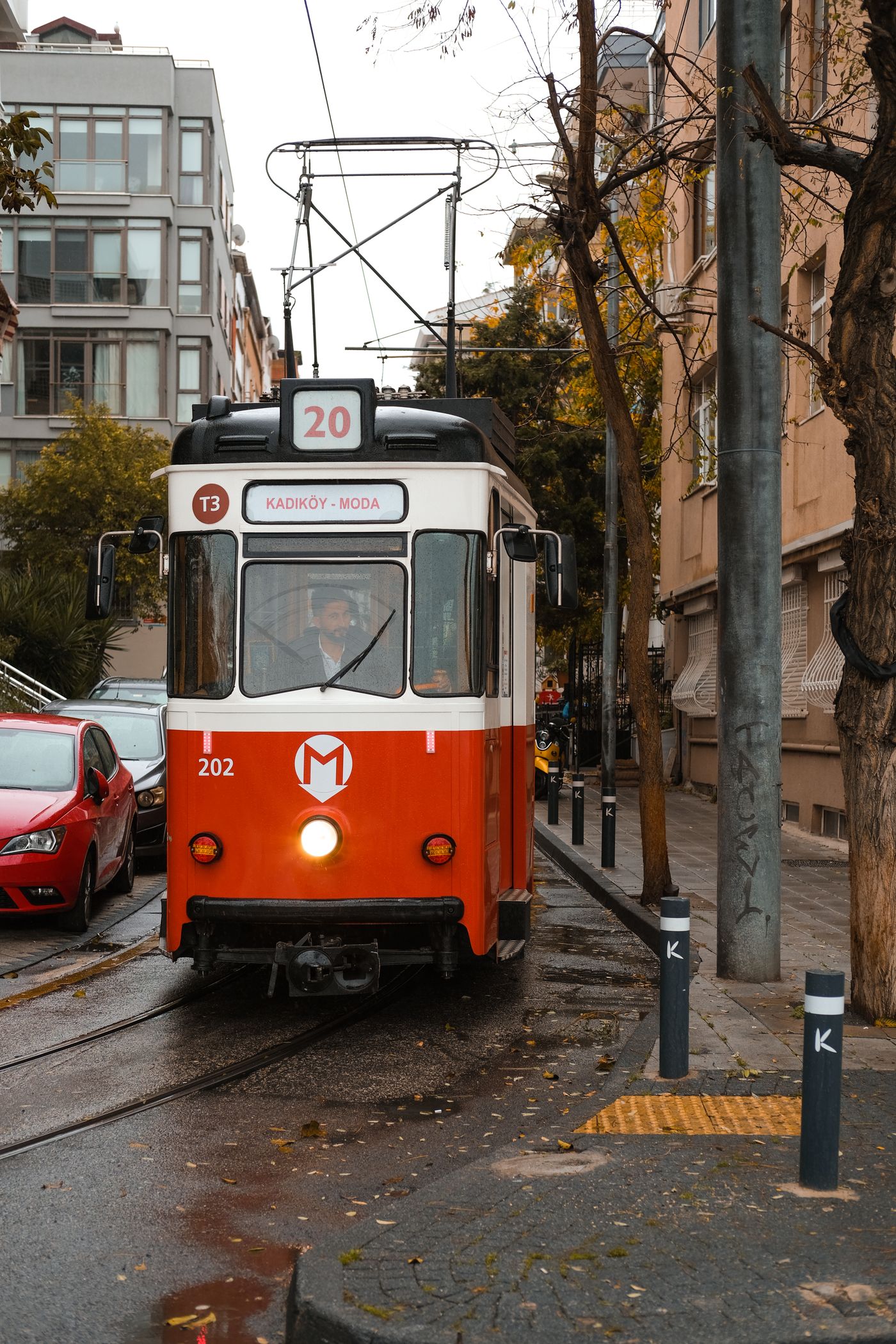
Here is the thing, though: as actual transport, the tram is slow and you absolutely don't need it. You can out-walk it without trying. Ride it anyway. Hop on for a stop or two between Bahariye and Moda, sit by the window, and let it do its rattling, photogenic thing. A small pleasure, not a commute.
How to actually walk it
Put it together and you have one of the easiest, most rewarding short walks in Istanbul, and it costs nothing. From the ferry it is about five minutes up to the bull; meet there, or just use it to get your bearings. Then climb Bahariye at whatever pace suits you, ducking into side streets, finishing at the opera house at the top.
The walk works at any hour. Mornings are calm and good for the bookshops. Late afternoon is when the avenue fills and the light goes gold on the upper floors. Evening, with the cinemas lit and the tram clanking past, is the best of all. You can do the whole spine in twenty brisk minutes or stretch it across a lazy half-day with stops for tea, a book and a sit-down. The quarter rewards the lazy version.
And if you get turned around at any point, you already know the fix. Walk to the bull and start again.