Moda
Moda by the sea
There is no charge to sit on the grass at Moda and watch the sun drop behind the old city. That, more than any single building, is the point of the place.
Most of Istanbul's famous waterfront is something you look at from a distance — across the Bosphorus, from a ferry deck, behind a fence at a paid attraction. Moda is the opposite. It is a piece of coast you actually sit on. The shoreline park runs along the cape on the Asian side, a long ribbon of grass and paving and low rock, and on any clear evening it fills up with people who came for nothing more complicated than the view and a glass of tea.
Locals will tell you it is the neighbourhood's living room, and the cliché happens to be true. This is where Kadıköy goes to do nothing in particular, together.
The seafront, end to end
Moda Sahili is the name for the seafront strip, and it curves for a good stretch around the headland the locals call Moda Burnu — the point. From the centre of Kadıköy you drop down the hill, the streets get quieter and leafier, and then the land just runs out into the Marmara. The path hugs the water the whole way.
What makes it work is that it was never tidied into a tourist promenade. There are benches, but people ignore them and sit on the grass. There are bins, and there is litter anyway by the end of a hot Sunday. Cyclists weave through, a little too fast. Someone is always selling corn or stuffed mussels from a cart. A dog-walker stops to let two dogs decide whether they are friends. It is ordinary, and that is the appeal.
I have watched a hundred sunsets in this city from balconies and rooftop bars that cost a fortune. The best of them were free, on a square metre of municipal grass at Moda.
The view does the heavy lifting. Look across the water and the whole historic peninsula is laid out — the domes and minarets of the old city catching the last light, the mouth of the Golden Horn, ships idling at the entrance to the Bosphorus. Further out, the Princes' Islands sit low on the horizon, and on the clearest evenings you can pick out the bigger ones. The sea is genuinely open here. The wind off it can be sharp even in June, which catches a lot of people out.
The iskele on the point
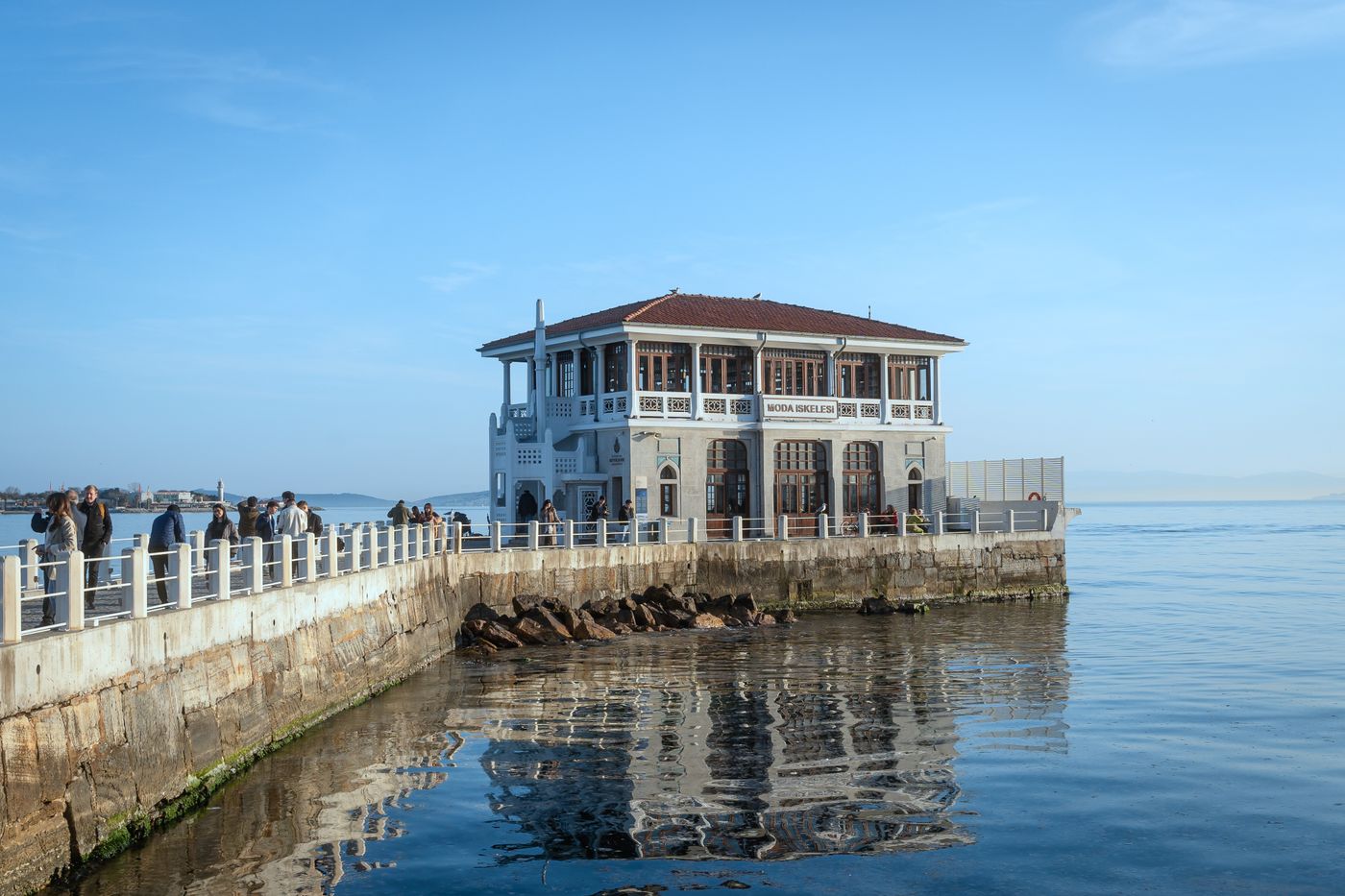
The one building everyone photographs is the old ferry pier, the Moda İskelesi. It sits right out on the water at the edge of the cape, a low, ornate pavilion with deep eaves and a wrap of arched windows, the kind of early-twentieth-century design that looks half-Ottoman, half-European seaside resort.
It dates from 1917 and was the work of Vedat Tek, one of the two leading architects of what gets called the First National Architectural Movement — the same hand that did the Haydarpaşa ferry pier a little up the coast. Boats stopped calling here a long time ago, and for years now the building has been a café-restaurant rather than a working iskele. You can sit inside or out, though you are paying for the address as much as the coffee, and there are cheaper drinks fifty metres away.
My tipWalk all the way out and look back at the iskele from the rocks instead. It is far more impressive seen against the sea than from the table you are charged to occupy, and the rocks are free.
Tea on the grass, tea at the garden
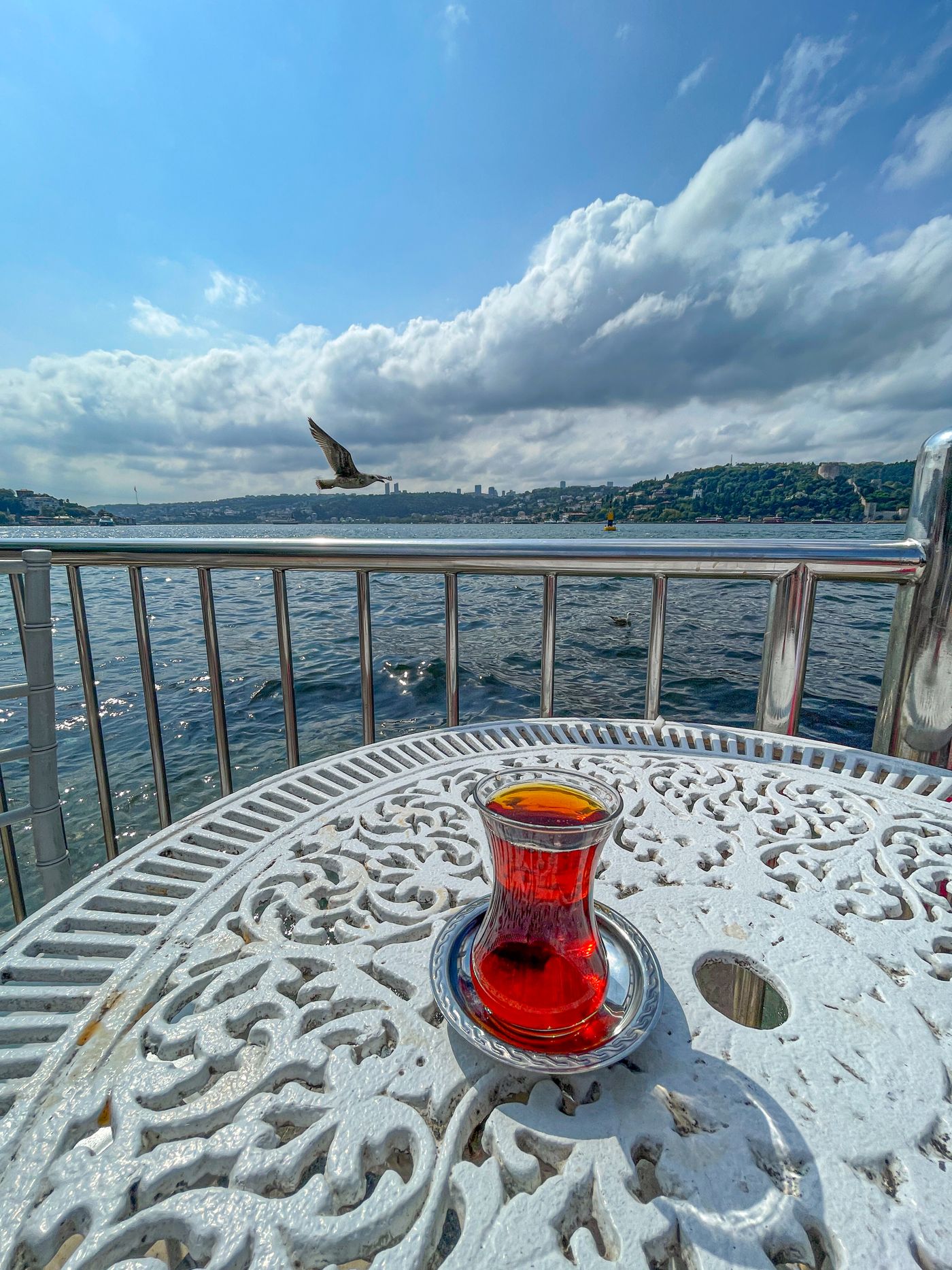
The thing to do at Moda, the actual thing, is to drink tea facing the sea. There is a tea garden out near the point — the Moda Çay Bahçesi — where you take a tulip glass of çay and a sesame simit and sit with the islands and the open Marmara spread out in front of you. It is cheap, it is busy, the waiters move fast, and the turnover of glasses on a Sunday afternoon must run into the thousands.
You do not have to use the garden. Half the shoreline brings its own. By late afternoon the grass is a patchwork of picnic blankets — families with spreads of food, couples, and clusters of students who have bought cans of beer from the corner shop and settled in to wait for the sun. Nobody minds. It is one of the more relaxed scenes in a city that can otherwise feel very buttoned-up, and it is entirely democratic. A student with one warm beer gets exactly the same sunset as the table at the iskele.
The cheap versionSimit and çay from a cart, eaten on the rocks, is the budget take on the whole thing and arguably the better one. A few lira, no waiting, the same horizon.
A history of getting in the water
Moda used to be where Istanbul came to swim. In the early twentieth century the cape had proper sea-baths — wooden bathing structures built out over the water, with separate sections, the genteel resort version of a day at the beach. They are long gone, but the habit never fully died.
People still swim off the point in summer. It is not a sandy beach and nobody pretends it is; it is a city swimming spot — concrete edges, ladders, rocks, and water that is colder and cleaner-feeling than you might expect this close to a metropolis of millions. On a hot July afternoon there will be teenagers throwing themselves off the lower rocks and older regulars doing slow, serious lengths parallel to the shore. If you swim, mind the boat traffic and do not expect changing rooms.
The long way round
If you have the legs for it, do not stop at the point. The path carries on past the cape and round toward Fenerbahçe, and eventually to the boats at Kalamış marina. It is a long, flat, easy walk along the water, far quieter than the busy stretch by the tea garden, and it is where a lot of locals go to actually move — runners, cyclists, people walking off a meal.
The marina end is a different mood: masts, halyards clinking, a forest of small boats, and cafés that are calmer and a touch pricier than the ones back in the thick of it. You can make a whole slow afternoon of walking out, drinking something at the marina, and ambling back to Moda in time for the sunset you came for.
Getting down there
From the centre of Kadıköy — the ferry terminal, the market, the bull at Altıyol — it is about a fifteen-minute walk downhill to the water. You lose the crowds within a couple of streets and the route through the back lanes of Moda is half the pleasure: quiet, green, full of cats and good corner cafés.
The other way is the nostalgic tram, the little antique-style loop that trundles around the Moda streets. It is slow and it is more of a ride than a serious form of transport, but it is genuinely charming and it deposits you near the shore. Children love it; so, quietly, do most adults.
If you only do one thingArrive about an hour before sunset, get a çay, find a patch of grass or rock facing west, and stay put until the lights come on across the water. Everything else at Moda is optional. This is the part nobody regrets.
Time it for a clear evening and you will understand why people who grew up here get sentimental about a strip of municipal grass. The sun goes down behind a thousand years of skyline, the ferries cross the channel one after another with their lights on, and for half an hour the entire Asian side seems to be sitting on the same shore, watching the same thing, in no hurry to leave.